
Since 2010, the Global Law Experts annual awards have been celebrating excellence, innovation and performance across the legal communities from around the world.
posted 7 hours ago
Dubai property is one of the most valuable assets many expat families own. The UAE’s real estate market has delivered extraordinary returns for long-term investors, and a Dubai property is often the cornerstone of a family’s financial security. It is also, without proper planning, one of the most difficult assets to pass to the next generation efficiently.
This article explains the mechanisms available to pass Dubai property to your children without the delay, cost, and uncertainty of the probate process.
When a Dubai property owner dies, the property does not automatically transfer to their intended heirs. Title to the property must be formally transferred through either the Dubai Land Department or, if there is a court process involved, through a probate or succession order from the relevant court.
If there is no registered will or other succession planning in place, the family must go through the UAE courts to obtain an order confirming their entitlement to the property. This process takes time — often many months, sometimes over a year — and involves legal fees, court fees, and the stress of navigating a foreign legal system during an already difficult period. The property typically cannot be sold or mortgaged during this process.
Even where the family eventually obtains their entitlement, there may be arguments between family members about who is entitled to what — particularly if the deceased’s domestic arrangements did not reflect a simple nuclear family model.
The most straightforward and accessible option for Dubai property owners is a DIFC Property Will, registered with the DIFC Wills Service Centre. This is a formal will that specifies exactly who should receive your Dubai properties on your death, registered with the DIFC Courts, which administer the estate according to your instructions.
The DIFC process is significantly faster than the mainstream UAE court process — administration typically takes a fraction of the time, and the outcome is predictable because the DIFC Courts will follow the will’s instructions. For most Dubai property owners who have not yet done any estate planning, a DIFC Property Will is the first step that should be taken.
For married couples, joint ownership of the Dubai property as joint tenants — with a right of survivorship — means that on the death of one owner, the property passes automatically to the surviving owner without the need for any probate process. The DLD can update the title registration on production of a death certificate.
This works well for the first death in a couple. On the second death, the property is in the sole name of the deceased and probate is required unless there is a will in place. Joint ownership is not a permanent succession solution — it defers the problem rather than solving it.
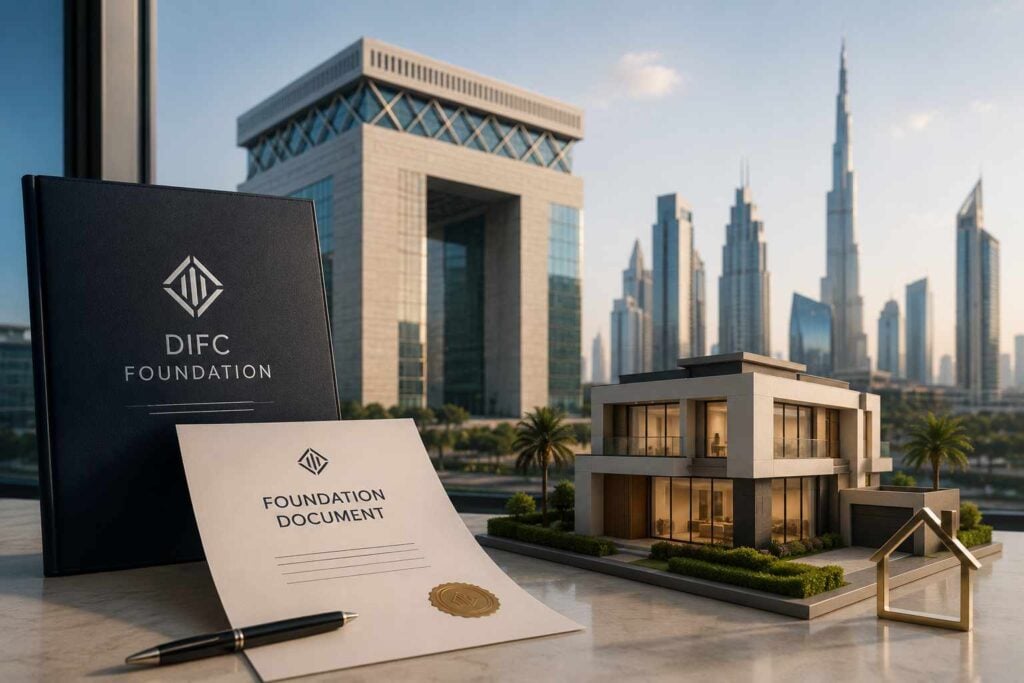
Holding the Dubai property through a company or a DIFC Foundation changes the succession question fundamentally. Instead of passing the property itself on death, you are passing shares in the company or an interest in the Foundation — or, in the Foundation’s case, the Foundation continues to own the property and the beneficiaries receive their entitlements according to the Foundation’s By-Laws.
Because the Foundation already owns the property during the Founder’s lifetime, there is no succession of the property on the Founder’s death — the Foundation simply continues. This sidesteps probate entirely for that asset.
The practical question is whether it is cost-effective to transfer an existing property into a company or Foundation — there are DLD transfer fees, typically four percent of the property’s value, which can be significant. For high-value properties or portfolios of properties, the one-time transfer cost may be well justified given the long-term succession and estate planning benefits.
For families who are purchasing Dubai property and want to build succession planning in from the start, buying directly into a company or Foundation structure avoids the transfer fee on a future reorganisation. The acquisition cost is typically the same whether the property is purchased in personal name or corporate name — the transfer fee is paid once, on purchase, regardless of the buyer’s identity. There may be minor differences in mortgage availability and terms when buying through a structure, which should be reviewed with a property finance specialist.
To speak with a Knightsbridge adviser about your situation, contact us at knightsbridge.ae or call our Dubai office for a confidential consultation.

posted 5 hours ago

posted 7 hours ago
posted 7 hours ago

posted 8 hours ago
No results available
Find the right Legal Expert for your business
Sign up for the latest advisor briefings and news within Global Advisory Experts’ community, as well as a whole host of features, editorial and conference updates direct to your email inbox.
Naturally you can unsubscribe at any time.
Global Advisory Experts is dedicated to providing exceptional advisory services to clients around the world. With a vast network of highly skilled and experienced advisors, we are committed to delivering innovative and tailored solutions to meet the diverse needs of our clients in various jurisdictions.