
Since 2010, the Global Law Experts annual awards have been celebrating excellence, innovation and performance across the legal communities from around the world.
posted 6 hours ago
By RSA Legal Solutions, India
India’s regulatory landscape for product compliance has undergone a significant transformation over the past decade. Through an expanding network of Quality Control Orders (“QCOs”), the Government of India has introduced mandatory product certification requirements across a wide spectrum of industrial and consumer goods. What was once limited to a relatively small number of products has evolved into one of the most significant market-access considerations for overseas manufacturers seeking to export to India.
For international businesses, compliance with India’s Bureau of Indian Standards (“BIS”) regime is no longer a technical issue delegated solely to quality or engineering teams. It has become a strategic legal and commercial consideration affecting market entry, manufacturing timelines, supply chain planning, customs clearance, contractual risk allocation and regulatory due diligence.
Unlike many jurisdictions where product conformity is primarily enforced through post-market surveillance, India’s regulatory framework frequently requires compliance to be demonstrated before goods are permitted to enter the domestic market. Consequently, manufacturers who identify certification requirements only after products have been shipped often encounter avoidable commercial disruption, increased logistics costs and contractual exposure.
For overseas legal advisers, understanding the structure and practical operation of India’s mandatory certification regime is increasingly essential when advising clients establishing manufacturing arrangements, appointing Indian distributors, negotiating supply agreements or exporting regulated products into India.
This article highlights the principal legal and commercial issues that overseas manufacturers should evaluate before entering the Indian market.
India’s mandatory product certification regime is principally governed by the Bureau of Indian Standards Act, 2016. However, the legal obligation to obtain certification generally arises not from the Act itself but from individual Quality Control Orders issued by the Central Government for specified products.
Each Quality Control Order identifies:
This distinction is important. The existence of an Indian Standard does not automatically make certification compulsory. Thousands of Indian Standards continue to operate on a voluntary basis. Certification becomes mandatory only when a specific Quality Control Order requires compliance.
Accordingly, determining whether a product requires BIS certification begins with identifying the applicable Quality Control Order rather than simply locating a corresponding Indian Standard.
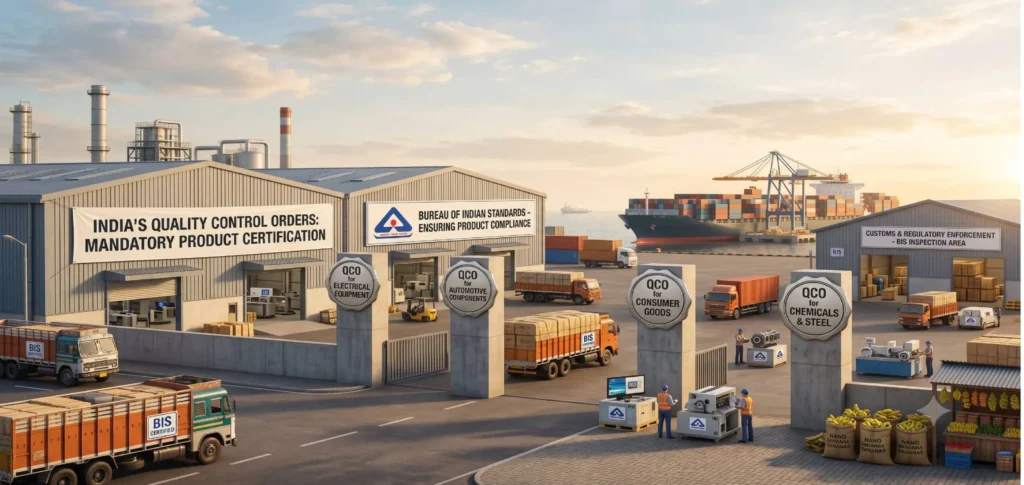
Over the past several years, India has significantly expanded mandatory certification requirements across multiple sectors. Products currently covered by various QCOs include electrical equipment, electronic products, chemicals, steel, automotive components, footwear, toys, household appliances, machinery, textiles and numerous engineering products.
The policy objective extends beyond product quality. Mandatory certification is increasingly viewed as an important regulatory tool for consumer protection, public safety, environmental compliance and enhancement of manufacturing standards. At the same time, the expansion of the QCO regime reflects India’s broader emphasis on quality assurance within domestic and international supply chains.
For overseas manufacturers, this means that regulatory assessment should now form part of the earliest stages of market-entry planning rather than being addressed immediately before shipment.
Perhaps the most important legal question is also the one most frequently overlooked.
The issue is not whether the product is capable of being certified; it is whether the product falls within the scope of a notified Quality Control Order in the first place.
This analysis is often more complex than it appears. Applicability depends upon the wording of the relevant notification, the prescribed Indian Standard, the technical characteristics of the product and, in many cases, the condition in which the goods are imported.
Manufacturers frequently assume that customs tariff classification alone determines whether certification is required. In practice, tariff classification is only one aspect of the analysis. Many Quality Control Orders define their scope through technical descriptions rather than tariff headings, and products classified under the same HS code may not necessarily be subject to identical regulatory obligations.
Accordingly, legal analysis should focus on the substance of the product rather than solely on commercial descriptions or customs classification.
India’s product certification framework consists of multiple conformity assessment mechanisms.
Depending upon the applicable legislation, compliance may require certification under the BIS Product Certification Scheme, registration under the Compulsory Registration Scheme (CRS) or another conformity assessment procedure prescribed under the relevant notification.
Each scheme operates differently and involves distinct eligibility requirements, testing procedures and compliance obligations.
A common misconception among overseas businesses is that every BIS approval follows the same certification process. In reality, determining the appropriate conformity assessment route is often one of the first legal issues that requires examination before production or export begins.
Selecting the incorrect certification pathway may delay market entry even where the product itself satisfies the relevant technical standards.
Unlike some regulatory systems where compliance obligations fall primarily upon the importer, India’s certification framework frequently centres upon the manufacturer itself.
Depending upon the applicable conformity assessment scheme, certification may be linked to the manufacturing facility, production processes and quality management systems rather than merely to the imported product. Consequently, overseas manufacturers often become active participants in the certification process alongside their Indian importers or distributors.
This has important commercial implications.
Regulatory obligations should be clearly allocated within supply agreements, manufacturing contracts and distribution arrangements. Responsibility for obtaining certification, maintaining approvals, implementing design modifications and responding to regulatory changes should not be left to implication.
Clearly drafted contractual provisions reduce uncertainty if regulatory issues arise after production has commenced or products have already entered the supply chain.
While BIS administers India’s conformity assessment framework, Customs authorities perform an equally important role by enforcing import conditions at the border.
Where imported goods appear to fall within the scope of an applicable Quality Control Order, Customs may seek evidence demonstrating compliance before permitting clearance.
Contrary to a common perception, many customs disputes do not arise because certification is entirely absent. They frequently arise because Customs and the importer adopt different interpretations regarding the scope of a Quality Control Order, the identity of the imported product or the applicability of a statutory exemption.
For overseas manufacturers, technical documentation therefore assumes considerable importance. Product specifications, engineering drawings, catalogues and test reports often become critical in demonstrating whether a particular notification applies.
A well-prepared technical record may significantly reduce delays during customs assessment.
From a legal perspective, one of the most effective methods of managing regulatory risk is through careful contractual drafting before products are exported.
International supply agreements should clearly address matters including:
Many disputes that ultimately reach legal advisers originate not from regulatory uncertainty but from poorly allocated contractual responsibilities between commercial parties.
Cross-border transactions involving regulated products should therefore integrate compliance planning into the commercial documentation from the outset.
International businesses entering the Indian market frequently encounter several misconceptions regarding the BIS regime.
Certification is required simply because an Indian Standard exists.
Not necessarily. Certification generally becomes mandatory only where a Quality Control Order specifically requires compliance.
CE marking, ISO certification or other international approvals automatically satisfy Indian requirements.
No. Although Indian Standards may draw upon internationally recognised standards, compliance with foreign certification regimes does not automatically establish compliance with Indian conformity assessment requirements.
HS classification alone determines BIS applicability.
Not always. The wording of the applicable Quality Control Order, technical characteristics of the product and prescribed Indian Standard often determine the regulatory position.
Certification can always be addressed after goods are shipped.
NO, infact in many cases, regulatory planning should begin well before production or shipment. Attempting to address certification issues after goods arrive in India may lead to avoidable delays and increased commercial costs. Sometimes goods may face seizure or re-export.
Businesses exporting products to India should consider incorporating the following measures into their compliance programmes:
Early legal review frequently proves significantly more efficient than attempting to resolve regulatory questions after products have entered the customs clearance process.
India’s mandatory product certification regime has evolved into a significant component of the country’s regulatory and trade framework. As the number of Quality Control Orders continues to expand, overseas manufacturers can no longer regard BIS compliance as a procedural formality to be addressed immediately before shipment. Instead, it should be viewed as an integral part of market-entry strategy, product design, contractual risk management and cross-border regulatory compliance.
For international legal advisers, the key issue is no longer whether India regulates product quality—it clearly does. The more important question is how those regulatory requirements should be integrated into commercial planning from the outset. Manufacturers that assess QCO applicability early, identify the appropriate conformity assessment pathway and allocate compliance responsibilities contractually are generally better positioned to navigate India’s evolving regulatory environment while reducing customs risk and avoiding unnecessary disruption to their supply chains.
Anshul Mittal is a Partner at RSA Legal Solutions, a boutique Indian law firm specialising in Customs, International Trade, Goods and Services Tax (GST), Foreign Trade Policy, Product Regulatory Compliance, Bureau of Indian Standards (BIS), Environmental (EPR) compliance, and allied regulatory laws.
Anshul regularly advises multinational manufacturers, overseas law firms, Fortune 500 companies and global supply chain participants on market-entry strategies, customs compliance, product certification requirements, Quality Control Orders (QCOs), foreign trade regulations and cross-border commercial transactions involving India. Her practice encompasses regulatory advisory, litigation before appellate authorities and courts, customs investigations, and strategic compliance planning for international businesses operating in the Indian market.
RSA Legal Solutions represents clients across diverse sectors including automotive, engineering, electronics, chemicals, consumer products, renewable energy, pharmaceuticals and industrial manufacturing. The firm’s practice focuses on delivering commercially pragmatic legal solutions to businesses understanding India’s evolving regulatory arena, with particular expertise in customs, indirect taxation, product compliance and international trade laws.
The firm regularly collaborates with overseas law firms, multinational corporations and international advisory firms, providing India-specific legal support on cross-border transactions, regulatory due diligence, compliance audits, dispute resolution and market-entry strategies.
For further information, please visit www.rsalegalsolutions.com or contact anshul@rsalegalsolutions.com.
Author

No results available


posted 5 hours ago

posted 5 hours ago

posted 5 hours ago

posted 5 hours ago
No results available
Find the right Legal Expert for your business
Sign up for the latest advisor briefings and news within Global Advisory Experts’ community, as well as a whole host of features, editorial and conference updates direct to your email inbox.
Naturally you can unsubscribe at any time.
Global Advisory Experts is dedicated to providing exceptional advisory services to clients around the world. With a vast network of highly skilled and experienced advisors, we are committed to delivering innovative and tailored solutions to meet the diverse needs of our clients in various jurisdictions.